Dec. 19, 2025 | Anna Flanagan
AHS celebrates the 100th anniversary of Huff Hall

By Anna Flanagan
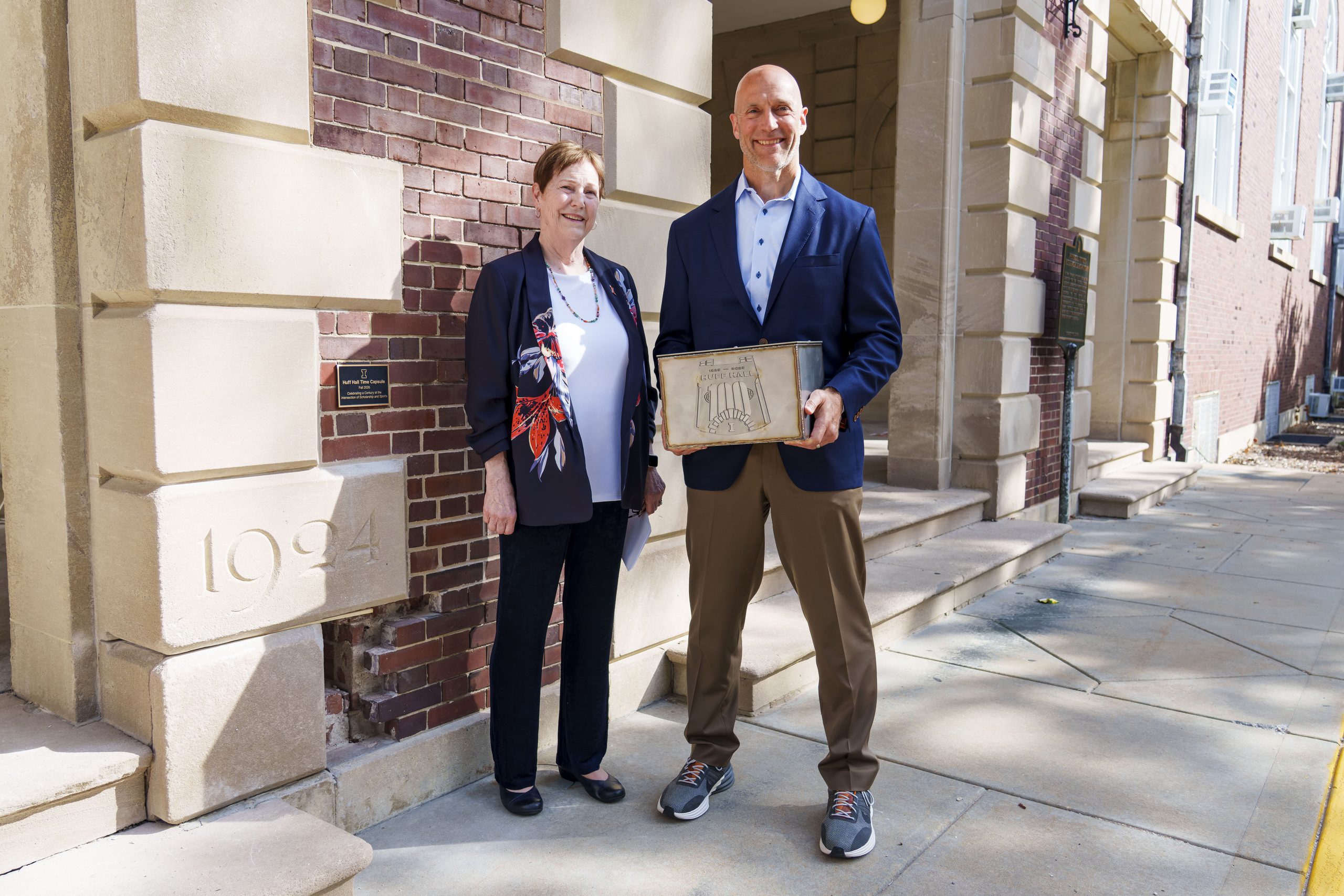
Many people still think of the home of the College of Applied Health Sciences as Huff Gym. The building opened in 1925 as the New Gymnasium, giving the University of Illinois men’s basketball team what was then state-of-the-art facilities for home games. Renamed for longtime athletic director and coach George Huff in 1936 after his death, Huff Gym later became Huff Hall to better reflect its significant role in the academic life of the university.
The four hallways on the first floor of the building surround the gym, which is still used for volleyball, wrestling and gymnastics events. But faculty associated with Huff have cemented its scholarly reputation as the site of pioneering research and groundbreaking advancements in health and leisure studies.
The Father of Physical Fitness
The early academics residing in Huff Gym were the faculty of the School of Physical Education. They included Seward Staley, who served as director and dean from 1936 to 1960. Staley was a strong advocate of building physical education programs around a sport-based curriculum and conducted extensive research on physical education and sport throughout his career. He guided the School of Physical Education to prominence as a leader in health-related research.
Staley’s own commitment to research-based practice influenced his faculty recruitment. In 1941, Thomas “T.K.” Cureton, known as the “father of physical fitness,” joined the School of Physical Education. He established the Physical Fitness Research Laboratory in Huff Hall, one of the first of its kind in the nation. He conducted cutting-edge research on what he called the six primary components of physical fitness—endurance, flexibility, agility, strength, power and balance—and revolutionized existing knowledge about weight and fitness, oxygen’s role in athletic performance and the role of exercise in cardiovascular health, among other things.
As Jack Berryman, then the official historian of the American College of Sports Medicine, observed in a 1996 article in Research Quarterly for Exercise and Sport, Cureton was the only fitness enthusiast of the 1950s (a group that included Charles Atlas and Jack LaLanne) “who produced the research to substantiate his beliefs regarding the positive influence of physical activity on health.” Cureton’s work helped to elevate the reputation of physical education and led to the establishment of research labs in departments across the country.
In addition to the hundreds of journal articles, books and research monographs published during his career, Cureton shared his beliefs widely through numerous lectures around the world, called Cureton Clinics, and frequent appearances in magazine and newspaper articles and on television programs focused on health and fitness. His son, Kirk Cureton, who himself had a long and distinguished career in kinesiology at the University of Georgia, said he wasn’t aware of his father’s reputation in the field of physical fitness science as a child. He participated in the Sports Fitness Experimental School that his father established in 1950 to improve the physical fitness of youth, still running today as the Sports Fitness Program, and recalls going to his father’s lab where Cureton and his graduate students assessed such things as cardiovascular health and muscle endurance.
Kirk Cureton’s knowledge of his father’s stature grew as he did, and he feels it played a positive role as he established his own career.
“My father was known, and it helped me with networking,” he said, adding that TK was “a good model.”
“What I learned from him was persistence and the value of hard work,” Cureton said. “He was devoted to his field. He loved what he did. He thought working at a university was the best thing you could do.”
Poised for the future
Many outstanding scholars walked the halls of Huff as the School of Physical Education evolved into the College of Applied Health Sciences. They established the first driver education teacher training program in the Midwest, created the first K-12 sex education curriculum that was adopted throughout the country, conducted a groundbreaking study on driving and alcohol consumption that resulted in the lowering of the DUI threshold from .15 to .10, conducted a comprehensive anti-smoking education study of youth that resulted in the first academic contribution to the annual Surgeon General’s Report on smoking and health, and put sport psychology on the map as a legitimate academic discipline, among many other contributions.

“Our current faculty engages in research that, in a lot of ways, wouldn’t have been possible without Cureton and the other pioneers,” she said. “We still focus on issues related to physical fitness and health, cardiovascular health, for example, which was so important in Cureton’s work. But we have developed a more discipline-focused approach, looking at biomechanics, exercise physiology, brain health or exercise psychology, and so much more.”
Graber noted that while the department has expanded far beyond its early focus on training school health educators, teacher training is still an important part of its mission as evidenced by its Physical Education Teaching Licensure program. Huff Hall is still an important hub for the department, she said, serving as the home of its three professional degree programs—Master of Public Health (MPH), Master of Health Administration (MHA) and Master of Science in Health Technology (MS-HT). Many health and kinesiology faculty have their offices and laboratories in Huff, where they are addressing current and emerging health challenges such as the role of technology in successful aging, gut health and chronic disease in underrepresented populations.
“Our research is cutting edge,” Graber said. “It’s innovative. It’s futuristic. We’re in a good position to tackle the problems of the next generation.”
Giants of recreation and leisure
Huff Hall also is the home of the Department of Recreation, Sport and Tourism, which had its beginnings in the Department of Physical Education for Women. That department, which included recreation in its curriculum, joined the Department of Physical Education for Men to form the School of Physical Education. The School began offering a bachelor of science degree in recreation in 1948, thanks to the efforts of Allen Sapora. The curriculum he developed became a model for programs around the country. Sapora believed strongly in the importance of applied research and was one of the first scholars to integrate research into recreation education and professional practice.
Charles Brightbill joined the Illinois faculty as a professor of recreation in 1951 and, working together with Sapora, built the program into one of the leading park and recreation education programs in the world. Brightbill had a well-established national reputation in the field of recreation by the time he joined the Illinois faculty, having served as the executive secretary of President Harry Truman’s Committee on Religion and Welfare in the Armed Forces, among other positions. In 1957, he became the inaugural head of the Department of Recreation, which was created when the School of Physical Education was reorganized and renamed the College of Physical Education. His advocacy of cooperation between citizens and professionals in the parks and recreation field played a significant role in the formation of the National Recreation and Park Association.
After Brightbill’s death, Sapora served as department head and created the Office of Recreation and Park Resources in partnership with University of Illinois Extension. He hired Joseph Bannon, who had completed his master’s degree in recreation at Illinois, to lead the new initiative. Like Sapora, Bannon firmly believed that practice in the parks and recreation field needed to be informed by scientific research, and that research needed to address real world issues. His own research focused on the development of recreation organizations. Laura Payne, professor of recreation, sport and tourism and Joseph J. Bannon Director of the Office of Recreation and Park Resources, said Bannon’s contributions are still relevant today.

“He was the expert nationally and internationally in public parks and recreation organizational development, leadership, management and administration,” she said. “His work addressed policy and practice, and how organizations relate to one another.”
Bannon, who became head of what was then the Department of Leisure Studies in 1973, was instrumental in strengthening the interdisciplinary nature of the department’s research, hiring faculty with backgrounds in such fields as psychology and sociology. He was a co-founding editor of the Journal of Park and Recreation Administration and, along with Allen Sapora, a founding Fellow of The Academy of Leisure Sciences, or TALS. Fellowship in TALS is a prestigious honor, one that many RST faculty and PhD graduates have earned since the organization’s founding in 1980. Among them are John “Jack” Kelly and Lynn Barnett, also giants in the field of leisure studies.
Kelly, in fact, played an instrumental role in establishing the field of leisure studies. He believed that knowledge of leisure theory would help practitioners make informed decisions and design more relevant and effective programs. He wrote the first textbook in the field of leisure studies, appropriately entitled Leisure, and encouraged scholars to address the sociological and psychological aspects of leisure.
“Jack Kelly is a legend in our field,” Payne said. “He was ahead of the curve on many societal issues and trends in the 1970s and early ‘80s, anticipating and working on healthy aging, work and leisure, socialization and leisure and family leisure. He really catapulted us forward by making our research more relevant and increasing our visibility to people outside of parks, recreation, sports, tourism and leisure studies.”
Barnett studied the role of play and playfulness in the lives of children and adults for more than 40 years. As a doctoral student in educational psychology, she became convinced that children learned as much or more outside of the classroom as they did within it. Over the years, she found that playfulness is a fairly stable construct that is related to cognitive and socioemotional functioning. Her research showed that playfulness was linked to flexibility in thinking, enjoyment, positivity, and social skill, and that it was often used to cope with anxiety.
“Lynn brought education, human development and play together in a way that hadn’t been done before,” said Monika Stodolska, Brightbill/Sapora Professor and associate head of recreation, sport and tourism. “She inspired generations of scholars, students and practitioners to look at play as being integral to learning, and socioemotional, physical, and cognitive development.”
The commitment remains
Scholars in the Department of Recreation, Sport and Tourism continue to believe in practice-based research and research-based practice. RST faculty still examine leisure’s role in the healthy development of individuals, families and communities, focusing on such contemporary issues as the role of sport in human and community development, equity in access to parks and green spaces and how social, cultural, environmental and political factors affect tourists and host communities. As RST professor and department head Carla Santos put it, “We keep our ears to the ground, listening and observing and staying connected to what’s going on in recreation, sport and tourism in order to be responsive to needs and priorities. That has been true of this department throughout the nearly 70 years we’ve been in Huff Hall.”
The College of Applied Health Sciences has grown beyond the walls of Huff, now also occupying Freer Hall and the Speech and Hearing Science Building. But one hundred years after its opening, Huff Hall remains the nerve center of AHS, and that’s just fine by Cheryl Hanley-Maxwell, dean of AHS.
“With the addition of the Khan Annex and modernization of instructional spaces, Huff wears its age well and is a comfortable academic home,” she said. “It’s a campus landmark and I’m proud that it’s the heart of AHS. But in the end, what really makes a building special are the people who work within it, our students, faculty and staff. We are blessed in AHS to have exceptional students, creative and dedicated faculty and skilled and supportive staff. I’m proud of all of them.”
Share on social