Oct. 22, 2022 | Vince Lara-Cinisomo
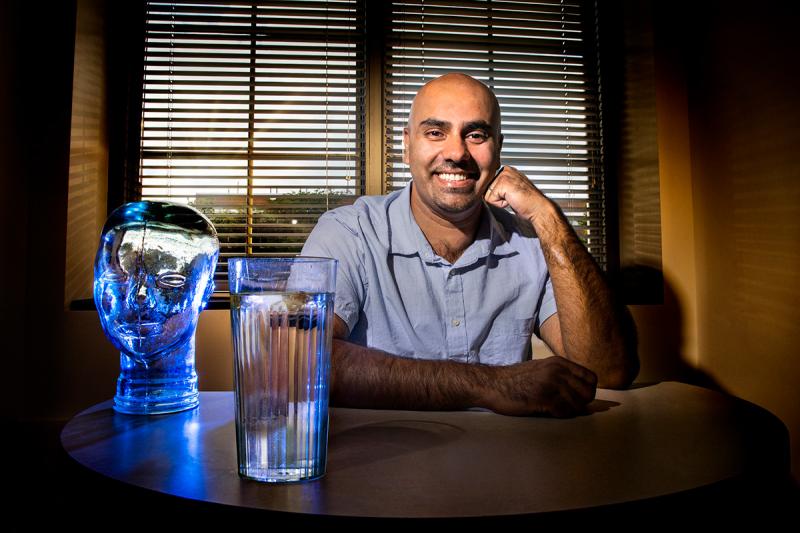
KCH Assistant Professor Jacob Allen got an NIH grant to study and combat rise of IBD.

In 1999, an estimated 1.8 million adults in the United States had inflammatory bowel disease (IBD), according to the Centers for Disease Control. By 2015, that number had risen to 3.1 million. Not only are incidences of IBD rising, but the costs associated with treating IBD have soared as well. According to a study published in 2019 in the journal Inflammatory Bowel Diseases, patients with IBD incurred a greater than three-fold higher direct cost of health care on a per-annual basis, compared with non-IBD controls ($22,987 vs $6,956 per-member per-year paid claims) and more than twice the out-of-pocket costs ($2,213 vs $979 per-year reported costs).
Statistics like those above are why researchers such as Assistant Professor Jacob Allen of the Dept. of Kinesiology and Community Health in the College of Applied Health Sciences at Illinois are working to determine a way to prevent IBD and other conditions caused by mucosal dysfunction. Allen received a $3.8 million grant from the National Institutes of Health (NIH) in July 2022 for his project titled “Role of epithelial ROS signaling in mediating psychological stress-induced mucosal dysfunction and colitis predisposition.”
In his grant application, Allen wrote, “exposure to psychosocial stressors increases the likelihood of developing IBD in genetically predisposed individuals, implicating a brain-gut axis in the IBD etiological framework.” His preliminary data “indicate(d) that the reactive-oxygen species (ROS)-generating capacity of intestinal epithelial cell (IECs) may be the most proximate causes of stress-induced dysbiosis and mucosal disruption.”
“If you look at inflammatory bowel disease rates over the past 30 to 40 years, you see an exponential rise in IBD rates, which is obviously problematic,” Allen said. “But also they’re often relapsing, remitting diseases, meaning that if you have IBD, you often will have periods of flares, symptoms, followed by periods of remission where you don’t have symptoms, which makes it kind of a unique type of disease in that way in that it’s a recurring disease. What we’re learning is that there are certain things that cause the recurrence, including diet, but also relevant for this grant, psychological stress can drive recurrence of disease flares.”
According to the Crohn’s and Colitis Foundation, the costs associated with people missing work, treatments, and medical costs that are indirectly associated with having IBD ranges from $30 billion to $50 billion annually.
As Allen explains, IBD consists of two major diseases in humans—Crohn’s disease and ulcerative colitis. They’re slightly different in their etiology, he said, meaning that the symptoms are a little different and they arise at different points in the intestine. Crohn’s disease usually arises in the small intestine and moves down to the colon, whereas colitis is generally focused in on the colon, located in the distal bowel region.
“Finding the mechanisms underlying why the disease occurs and then also what causes flares and what causes recurrence is also important,” he said, “and so that’s kind of the big picture goal of why this is an important thing to study.”
In his grant application, Allen cites “an emerging line of work has established that stress-induced disruptions to the gut microbiota may be the most proximate cause of stress-induced IBD predisposition.” Researchers in Allen’s lab found that a mouse-adaptive pathogen was more effective at inducing colitis in mice colonized by a microbiota from mice exposed to a chronic social defeat stressor.
Additionally, they found that stress exacerbates chronic colitis.
“We think that essentially comes down to a disrupted communication between the microbiome and the host immune system,” he said. “And what happens is that the adaptive immune system, which recognizes certain bacteria and can attack those bacteria, is disrupted to some degree with IBD. It’s thought to be similar to (but not the same as) classical autoimmune diseases, whereby T cells and B cells start to mistakenly attack our own cells. However, with IBD, it appears that the immune system develops abnormal inflammatory reactions to our endogenous microbiota.” What sets off this reaction, however, is not fully understood. Allen and his team hypothesize that excessive production of stress hormones may be one of the key factors underlying IBD predisposition.
Allen explains that the body and bacteria, under normal circumstances, under a healthy condition, live in homeostasis. However, when people experience high levels of psychological stress, Allen said, that communication pathways get shut down. That can lead to mucosal dysfunction, through which diseases such IBD can occur, as well as food allergies and other gut-related conditions.
“Certain bacteria bloom in response to psychological stress that aren’t necessarily good. They start to break down what we call the mucosal barrier—a line of mucus that lines our colon and protects the cells,” he said. “Understanding how the hormone interacts with epithelial cells or what bacteria are doing to actually degrade the mucus, that kind of stuff will give us targets that we can then look at for potentially modifying with pharmaceuticals or others that would limit IBD. So that’s kind of the big picture goal.
“We want to get back to that balance of where the microbes and our cells live in harmony. But we have to understand the mechanisms behind what happens or what goes wrong in the first place for us to do that.”
Editor’s note:
To reach Vince Lara-Cinisomo, email vinlara@illinois.edu.
Share on social